
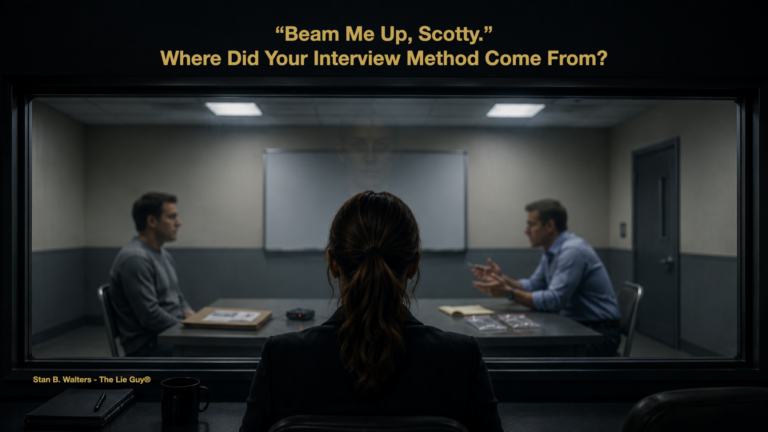
by Stan B. Walters - The Lie Guy®
ORCID: 0009-0002-1063-0519
Most people recognize the famous Star Trek line, “Beam me up, Scotty.” There is only one problem: Captain Kirk never actually said it that way. The phrase became accepted because people repeated it until it sounded right. The same thing can happen with interview methods. Investigators may inherit practices without knowing where they came from, repeat methods that feel familiar but are not reliable, and then struggle to explain those choices when the interview is reviewed.
The Source Often Stops at the Instructor
When investigators are asked where they learned a method, the answer is usually the academy, a conference, a senior investigator, or a particular instructor. That tells us who delivered the lesson, but not where the method began or what supports it. As the lesson passes from one person to another, the original source can disappear and the method can change along the way.
Familiar Does Not Mean Reliable
Repeated ideas begin to feel true. Claims about eye contact, posture, confidence, or “too many details” may sound reliable because investigators have heard them for years. Familiarity, however, is not evidence. Experience can help explain how a method is used, but it does not prove that the underlying claim is accurate.
The Method Must Survive Review
Interview methods do not stay inside the interview room. Supervisors, prosecutors, defense attorneys, judges, and jurors may later examine what was done and why. “That is how I was taught” may not be enough when the next question is, “What was that instruction based on?” Unsupported methods can damage both the interview and confidence in the investigator’s judgment.
Inspect the Source
“Beam me up, Scotty” became accepted because repetition made it sound authentic. That is harmless in a conversation about television. It is not harmless when repeated claims shape investigative practice. Investigators should know where a method came from, what supports it, and what limits apply before they use it or teach it to someone else.
© Copyright 2026 by Stan B. Walters All RIghts Reserved. Brief excerpts may be quoted with attribution and a link to the original article. Reproduction, redistribution, or use in training materials requires written permission.
Author’s Note: Stan B. Walters’ work is grounded in more than four decades of field experience and continuously reviewed against current peer-reviewed research. Explore additional articles, studies, and professional publications on the Research & Publications page.