by Stan B. Walters, The Lie Guy®
ORCID: 0009-0002-1063-0519
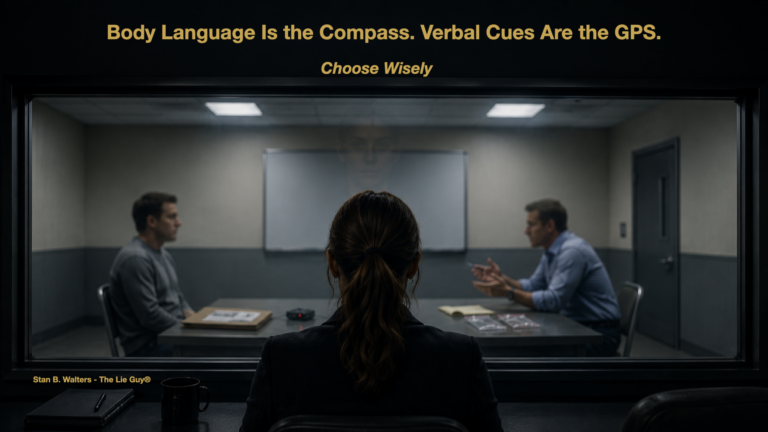
Every investigator wants to stay on course during an interview. The problem is that body language and verbal cues do not provide the same level of direction. Body language works more like a compass: general, interpretive, and vulnerable to error. Verbal cues work more like GPS: they give the investigator a clearer route, help correct mistakes, and keep the interview tied to the subject’s own words. That difference matters because body-language-driven interviewing creates three major risks: a larger margin of error, constant mental recalculation, and the possibility of not knowing the interview went off course until it is too late.
Margin of Error
The first problem is margin of error. A compass can point you in a direction, but a small mistake at the beginning can become a major miss by the end of the trip. Body language creates the same risk. The investigator sees a movement, posture shift, pause, glance, or expression and then has to decide what it means. If that interpretation is wrong, the interview may begin drifting immediately. Stress can be mistaken for deception. Confusion can be mistaken for resistance. A normal reaction can become the basis for a bad assumption.
Verbal cues reduce that risk because they give the investigator something concrete to follow. Words create a route. Time, people, places, actions, sequence, missing information, vague language, and changes in explanation all give the investigator specific points to examine. When a timeline changes, the investigator can return to it. When a person appears in one version but disappears in another, the investigator has a precise point to clarify. The route can be checked while the interview is still moving.
Mental Demand
The second problem is mental demand. Compass navigation requires constant recalculation. You have to keep checking direction, watching terrain, correcting angles, and deciding whether the path still matches the destination. Body-language interpretation creates the same workload. The investigator has to observe the behavior, compare it to context, consider timing, look for patterns, and decide whether it means anything at all — all while the subject is still talking.
That is where mistakes multiply. The more mental energy spent interpreting body language, the less attention remains for the subject’s actual information. The investigator may miss a time gap because he is focused on posture. He may miss a language shift because he is watching eye contact. He may miss a contradiction because he is trying to decide what a movement means. Verbal cues require less guesswork and produce more usable information. They keep the investigator focused on what the subject actually said.
Ultimate Destination
The third problem is destination. With a compass, you may not know you are wrong until you arrive somewhere you never intended to be. Worse, if the terrain is unfamiliar, you may keep walking and convince yourself you are still on course. That is one of the greatest dangers in a body-language-driven interview. The investigator may never realize the original interpretation was wrong. Nervousness, defensiveness, or silence may all be treated as confirmation of the first assumption.
Verbal cues help prevent that because they allow the investigator to place a pin in the destination. The goal is not to prove that a gesture meant deception. The goal is to test the reliability of the account. What happened? What changed? What is missing? What can be confirmed? When the subject’s words become the route, the investigator has specific points to return to, test, and clarify.
Compass or GPS? Choose Wisely!
Body language may still have value as a warning light. It may tell the investigator that something changed or that the pace needs adjustment. But it should not be the primary navigation system. The margin of error is too great, the mental demand is too high, and the destination is too uncertain. Body language is the compass. Verbal cues are the GPS. In the interview room, choose the route that helps you stay on course.
© Copyright 2026 by Stan B. Walters All Rights Reserved. Brief excerpts may be quoted with attribution and a link to the original article. Reproduction, redistribution, or use in training materials requires written permission.
More on Body Language, Verbal Cues, and Interview Reliability
Want to go deeper?
Visit my Research & Publications page for more articles, research, and resources on evidence-based interviewing.