The Interview Room Archives

Classic Articles on Investigative Interviewing

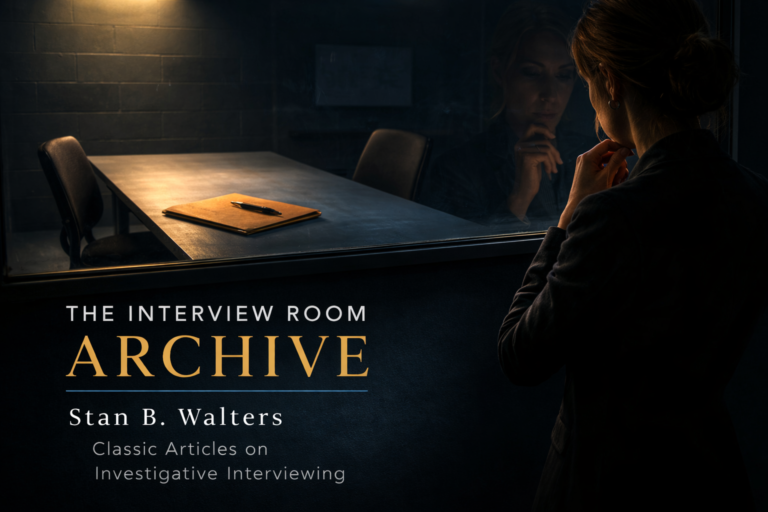
The Interview Room Archive banner showing a two-way mirror view of an investigative interview room with table and case file as a female investigator observes, representing classic investigative interviewing articles by Stan B. Walters.

For many years Stan B. Walters published The Interview Room, an international electronic magazine read by investigators, law enforcement professionals, and interview specialists around the world.

The articles in this archive explore investigative interviewing, interrogation strategy, deception detection, and behavioral analysis—ideas that helped challenge outdated assumptions and shape modern thinking in the field.


Confession Motivators: Gain or Pain

Citation: Originally published in The Interview Room
January 2008 (Volume 7, Number 1) — by Stan B. Walters.

For each of us, the only reason we change our minds about a decision that we have already made is when someone or something convinces us to abandon our first decision and a new or different point of view. In our mind in some measurable one when see the new position we have taken is being more rewarding or satisfying than the old. We have made the change after we have been motivated by our perception of "gain" or "pain." The same evaluation process is being made in the mind of our interview or interrogation subject while we are persuading them to change their current position and begin to cooperated with us and comply with our requests for information or even confession. If you can understand the "gain" or "pain" motivation of your subject and demonstrate to your subject a big distinction between the two, you'll have a better chance at gaining compliance, cooperation and confession.

In the Gain vs. Gain scenario, you subject has already concluded that he has much more to gain by remaining consistent with the position he has already assumed. First you have two hurdles to overcome, your subject's commitment to staying consistent with his decision and second demonstrating to him or her the position you want them to choose will provide them even more to gain than they may realize. In this case you'll need to acknowledge that you subject does have some things to gain by sticking with their decision and point out that the new point of view may also have those very same rewards. That it itself however, is not enough to move your subject. You'll have emphasize the advantages your subject has overlooked or has undervalued in terms of their importance to him and his "gain" objective.

In the second scenario which is Pain vs. Pain, there is the possibility that your interviewee has seen no gain for them at all by accepting your conclusions and you'll have a long road of persuasion ahead of you. It that case you'll need to demonstrate to the subject that they have overlooked some pain issues with their point of view and to accept your proposition. Your recommended position may also afford the subject some "pain" but not nearly as much as what they had not anticipated if they decided to "stand" by his initial choice. In most cases, carefully listening to your subject and their reasons for rejecting your proposal, you'll hear the gain-pain issue or issues that is driving your subject's resistance. You'll need to focus on those issues because their are important to your subject but may not be that important to you.

The final scenario is usually the easiest to deal with and that's the Pain vs. Gain format. In this case, it is much easier to convince your subject to abandon their choice to resist your recommendations to solve the issue. They already see themselves has having to deal with some level of "pain" as a result of their behavior and all you have to do is show them the "light" and get them to look forward and see to "gains" they can make by reevaluating their current pain-filled situation. In many cases, just pointing out what may be obvious "gain" to you is all that is needed because your subject is "blinded" by their current state and has missed the benefits of changing they judgment about the possible outcomes of cooperation.

In any of the three scenarios above, the interviewer has to realize that their subject is motivated by "their" perception of Gain vs Pain. The evaluation by the subject as to what they define as gain or pain may not even be close to what you as the interviewer think is worth gaining or avoiding. Once the interviewer recognizes their subject's gain or pain motivation he can key in on those issues. The greater the distinction you can make between Gain - Gain, Gain - Pain, and Pain - Pain, the more likely and the more quickly you'll get the subject to come to the conclusion to abandon their current preferred decision and accept the interviewer's recommendation.

© 2008 Stan B. Walters / Third Degree Publishing. All rights reserved.
This article is part of The Interview Room Archive Series, preserving classic writings on investigative interviewing and interrogation strategy.

Many of the concepts introduced in these early articles continue to evolve today through Stan Walters’ work on the Cognitive Reliability Framework and evidence-based interview practices.

Casey Anthony

She Told Us Where to Find Caylee Anthony!

Stan B. Walters

Back in July, Casey Anthony told us where to find her daughter’s body in her recorded jail telephone calls.  She said she felt Casey was okay and was nearby.  Check my blog for July 28th and note my observations.

I wrote  “She feels that Caylee is nearby or near her home.  Caylee may very
well be found very close to home.  If she is it’ll be someplace that
Casey is very familiar with and / or has been there several times.

I’d really start working on these two comments by Casey.  I think they may be the keys to getting an admission or confession.”

Caylee Anthony has been found about 1/4 mile from her house.  The area where she was found was a location that Casey Anthony is reported to use as a “hangout” with her friends when she was in high school and apparently is very familiar with the location. 

I understand that the location where Caylee was found has been and is often under water making it difficult to discover her body before now.

Now Casey Anthony’s words are REALLY going to haunt her.  Her lies about Zany, Zany’s mother, Zany working at Universal studios, and all her “trips” to help find Caylee.  I’m curious as to how the “bounty hunter” is going to explain this but more importantly, what tactic will her attorney employ.

I’ll bet we get the “scared mother” story, the “kidnapped baby story” and there will be a BIG attack on her interview / interrogation, the forensics, and attempts to get both excluded.  I’m also interested in how Grandmother is going to handle all this.

Keep watching!  I’ll bet there will be more to this soap opera yet to come!
That’s just my opinion.  Let’s see if I am right.

Stan
“The Lie Guy®”
[email protected]
Facebook.com
Twitter.com
LinkedIn.com
Get “The Truth About Lying.”