The Interview Room Archives

Classic Articles on Investigative Interviewing

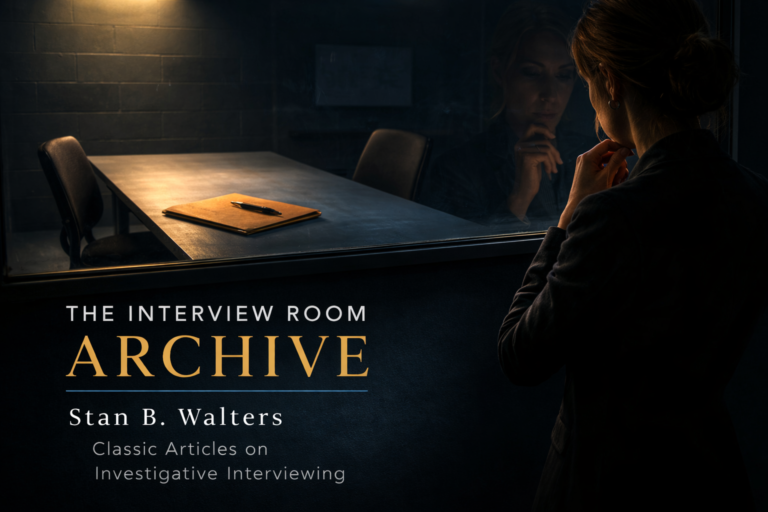
The Interview Room Archive banner showing a two-way mirror view of an investigative interview room with table and case file as a female investigator observes, representing classic investigative interviewing articles by Stan B. Walters.

For many years Stan B. Walters published The Interview Room, an international electronic magazine read by investigators, law enforcement professionals, and interview specialists around the world.

The articles in this archive explore investigative interviewing, interrogation strategy, deception detection, and behavioral analysis—ideas that helped challenge outdated assumptions and shape modern thinking in the field.


Confession Motivators: Gain or Pain

Citation: Originally published in The Interview Room
January 2008 (Volume 7, Number 1) — by Stan B. Walters.

For each of us, the only reason we change our minds about a decision that we have already made is when someone or something convinces us to abandon our first decision and a new or different point of view. In our mind in some measurable one when see the new position we have taken is being more rewarding or satisfying than the old. We have made the change after we have been motivated by our perception of "gain" or "pain." The same evaluation process is being made in the mind of our interview or interrogation subject while we are persuading them to change their current position and begin to cooperated with us and comply with our requests for information or even confession. If you can understand the "gain" or "pain" motivation of your subject and demonstrate to your subject a big distinction between the two, you'll have a better chance at gaining compliance, cooperation and confession.

In the Gain vs. Gain scenario, you subject has already concluded that he has much more to gain by remaining consistent with the position he has already assumed. First you have two hurdles to overcome, your subject's commitment to staying consistent with his decision and second demonstrating to him or her the position you want them to choose will provide them even more to gain than they may realize. In this case you'll need to acknowledge that you subject does have some things to gain by sticking with their decision and point out that the new point of view may also have those very same rewards. That it itself however, is not enough to move your subject. You'll have emphasize the advantages your subject has overlooked or has undervalued in terms of their importance to him and his "gain" objective.

In the second scenario which is Pain vs. Pain, there is the possibility that your interviewee has seen no gain for them at all by accepting your conclusions and you'll have a long road of persuasion ahead of you. It that case you'll need to demonstrate to the subject that they have overlooked some pain issues with their point of view and to accept your proposition. Your recommended position may also afford the subject some "pain" but not nearly as much as what they had not anticipated if they decided to "stand" by his initial choice. In most cases, carefully listening to your subject and their reasons for rejecting your proposal, you'll hear the gain-pain issue or issues that is driving your subject's resistance. You'll need to focus on those issues because their are important to your subject but may not be that important to you.

The final scenario is usually the easiest to deal with and that's the Pain vs. Gain format. In this case, it is much easier to convince your subject to abandon their choice to resist your recommendations to solve the issue. They already see themselves has having to deal with some level of "pain" as a result of their behavior and all you have to do is show them the "light" and get them to look forward and see to "gains" they can make by reevaluating their current pain-filled situation. In many cases, just pointing out what may be obvious "gain" to you is all that is needed because your subject is "blinded" by their current state and has missed the benefits of changing they judgment about the possible outcomes of cooperation.

In any of the three scenarios above, the interviewer has to realize that their subject is motivated by "their" perception of Gain vs Pain. The evaluation by the subject as to what they define as gain or pain may not even be close to what you as the interviewer think is worth gaining or avoiding. Once the interviewer recognizes their subject's gain or pain motivation he can key in on those issues. The greater the distinction you can make between Gain - Gain, Gain - Pain, and Pain - Pain, the more likely and the more quickly you'll get the subject to come to the conclusion to abandon their current preferred decision and accept the interviewer's recommendation.

© 2008 Stan B. Walters / Third Degree Publishing. All rights reserved.
This article is part of The Interview Room Archive Series, preserving classic writings on investigative interviewing and interrogation strategy.

Many of the concepts introduced in these early articles continue to evolve today through Stan Walters’ work on the Cognitive Reliability Framework and evidence-based interview practices.

Jerry Sandusky’s Jaw-Dropping Interview:

Detection of Deception

Stan B. Walters

Jerry Sandusky’s by Bob Costas last night was absolutely stunning!  Bob did a great job no doubt but to me, Sandusky’s responses telegraph the thoughts and behaviors of a man who knows his actions where wrong and is having trouble explaining and justifying what he is alleged to have done.

His private parts may have touched her son. Wished it never happened.  Need forgiveness. Shouldn’t have showered with those kids. “Am I sexually attracted to young boys? “ He enjoys kids and loves to be around them. “I have done some of those things.” What amazing statements by a man under suspicion of “inappropriate behavior” with boys who are minors!

(See the video here on YouTube)

Some of my quick observations that would set off alarm bells if I were conducting a criminal interview of Jerry Sundusky:

1.    Did not touch their leg with sexual intent. Uh huh.  Why were you touching their leg while they were all nude in the shower?

2.    Told the mother of one boy he wished it hadn’t happened and needed forgiveness.  He told her he wishes he was dead. So what have you done that you feel need to be forgiven?  Why do you feel you need to die?

3.    Tells us he enjoys kids and loves being around them.  Strangely they are all young boys and always in and around showers.  I see a possible repetitive pattern of sexual fantasy going on here.

4.    Describes his actions with the boys in the showers as “just horsing around.”  Really?  How’s that for rationalizing your behavior?

5.    Another witness reported Jerry Sandusky performing oral sex on a child in the showers.  Another shower scene with Sandusky.

6.    Another witness reported Sandusky was in the shower with a young boy and he heard rhythmic “slapping sounds” that the witness called a rape. Sandusky said the boy had turned off the showers, he was sliding across the floor and Sandusky says he was snapping a towel.  That must have been painful for somebody in the showers.

7.    Costas asked Jerry Sandusky if he was a pedophile to which Sandusky quickly responded “No.”  But when asked if he was sexually attracted to young boys, Sandusky immediately stalls before answering which is a sign of cognitive load and that the question has created some significant stress on the part of the subject.  It means that Costas’ question was spot on. Once Sandusky starts to answer, we hear cognitive dissonance in that Sandusky’s thoughts are literally racing and he is in deep trouble trying to respond in a way that minimizes or explains away his actions.

Already there are hints of more boys who are victims.  I’m afraid the list could get VERY long.  We are ALSO going to hear of more potential victims of Sundusky’s behaviors that never made it to the showers.

Authorities need to find ALL these victims and conduct extensive forensics interviews of each by trained forensic child interviewers.  Then these victims will need extensive attention and counseling.  These victims have been suffering for a long time thinking they were bad and that they were the only ones.

This case will go way beyond the confines of Penn State.  I predict that if they are disclosed, there will be many incidents not related to his time on the Penn State campus and therefore lots of other people who did not report Sandusky for his actions.
Not doubt Sandusky is to blame for his own actions but I don’t think that the administration at Penn State are the only ones who didn’t report what they knew.

PS Kudos to Bob Costas for a great interview, especially on the fly.

At least that’s my opinion.

Stan B. Walters, CSP
“The Lie Guy®”
Thelieguy.com
TheLieGuyAcademy.com
Facebook
Contact Stan!