

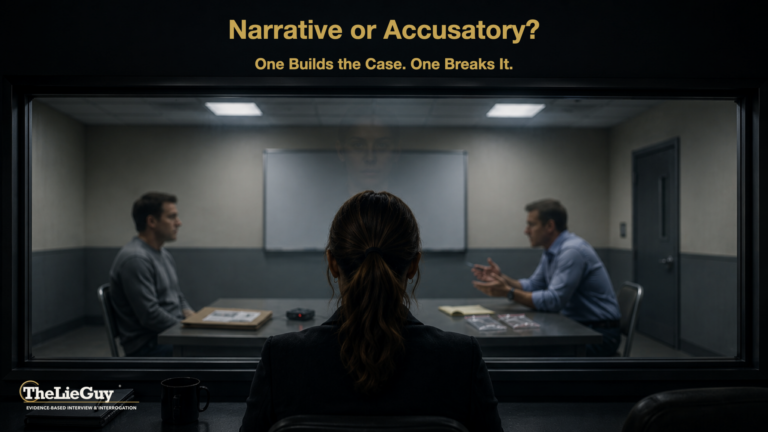
One Builds a Case. The Other Breaks it.
by Stan B. Walters The Lie Guy®
ORCID: 0009-0002-1063-0519
"Choices made in the interview room eventually play out in a courtroom."
Investigators often debate whether narrative interviewing or accusatory interviewing is more effective. The discussion usually centers on techniques—what questions to ask, when to challenge a subject, or how much pressure should be applied. I believe the real difference begins much earlier. It begins with the investigator's objective before the first question is ever asked.
If the primary objective is to obtain an admission or confession, the interview naturally moves in one direction. If the objective is to discover what the subject actually knows and then test the reliability of that information, the interview follows a very different path. Those two objectives influence every decision that follows, from the types of questions asked to the way investigators evaluate the answers they receive.
The distinction is important because interviews are not measured by how persuasive the investigator appears. They are measured by the quality of the information they produce. Reliable information can be corroborated, challenged, tested against independent evidence, and ultimately defended in court. That makes the investigator's initial objective one of the most important decisions in the entire investigative process.
Information Is More Valuable Than Agreement
One of the most persistent misconceptions surrounding interviewing is the belief that deceptive people reveal too much information. The opposite is often true. Individuals attempting deception frequently avoid details because details create opportunities for contradiction, verification, and discovery. They simplify events, omit context, and provide only enough information to move the conversation forward without increasing their risk.
Narrative interviewing is designed to address that problem. Rather than limiting subjects to a series of narrowly focused questions, investigators encourage them to construct their account in their own words. As the narrative unfolds, additional details naturally emerge regarding people, locations, timing, actions, conversations, and sensory experiences. Research has repeatedly shown that information-gathering approaches can produce substantially more investigative information than more restrictive interviewing methods. More information does not automatically mean more truth, but it does provide investigators with far more opportunities to corroborate, challenge, and evaluate the reliability of the account.
The Investigator's Mindset Influences the Questions
The objective investigators carry into the interview room has a profound influence on the questions they ask. When investigators believe they already know what happened, it is natural for questions to become increasingly focused on confirming that conclusion. The interview gradually shifts from an exercise in discovery to an exercise in verification of an existing belief.
This is where confirmation bias quietly enters the process. It rarely appears because investigators intentionally ignore contradictory information. More often, it develops because investigators sincerely believe they have already identified the correct explanation. Questions become narrower. Alternative possibilities receive less attention. Information supporting the investigator's theory becomes more persuasive than information suggesting another interpretation.
Narrative interviewing approaches the problem differently. Rather than attempting to confirm a single explanation, investigators first encourage a complete account and then evaluate that account against known facts, physical evidence, witness statements, and competing hypotheses. The interview remains a process of inquiry rather than a search for agreement.
Control Has a Cost
Many accusatory interviewing methods attempt to establish psychological control by convincing subjects that continued denial is futile. Investigators may reveal evidence, discuss witness statements, or disclose investigative facts in an effort to demonstrate that deception has already failed. The strategy is intended to persuade the subject that cooperation is the only reasonable option.
While this approach may appear logical, it introduces an important investigative concern. Every fact communicated by the interviewer becomes information now available to the subject. If those same details later appear in the subject's statement, investigators must determine whether the information originated with the subject or whether it was inadvertently supplied during the interview itself.
That distinction becomes increasingly important when evaluating the reliability of the statement. Investigators are attempting to discover what the subject knows independently. The interview should not become the source of new evidence. Once those two become difficult to separate, the value of the statement as reliable evidence begins to diminish.
Conclusion
The interview is where the case begins to take shape. Every question either strengthens or weakens the reliability of the evidence that follows. Narrative interviewing is designed to gather information, challenge assumptions, and preserve the integrity of the subject's account. Because, in the end,
"Choices made in the interview room eventually play out in a courtroom."
© Copyright 2026 by Stan B. Walters All Right Reserved
Brief excerpts may be quoted with attribution and a link to the original article. Reproduction, redistribution, or use in training materials requires written permission.