
By Stan B. Walters
ORCID: 0009-0002-1063-0519
Most criminal investigations begin after the event has already occurred. Investigators document the scene, collect evidence, identify witnesses, and then begin using investigative interviewing techniques of those involved. While those steps are essential, they often create a subtle trap. The interview becomes focused on reconstructing the crime itself rather than understanding what made the crime possible. If investigators concentrate only on the event, they risk overlooking the decisions that led to it, missing evidence of planning and intent, and settling for a story that explains what happened without revealing why it happened. The most productive interviews often begin by examining the crime before the crime.
Looking Beyond the Criminal Event
The criminal act is usually the final chapter of a much longer story. Long before a burglary, fraud, arson, assault, or homicide occurs, there are conversations, decisions, frustrations, opportunities, and preparations. People begin justifying actions, weighing risks, solving problems, or testing boundaries. Those earlier events rarely leave fingerprints or DNA, but they leave memories. By encouraging subjects to discuss the events leading up to the offense rather than immediately focusing on the offense itself, investigators often discover motives, relationships, and circumstances that provide meaning to the physical evidence collected later. The interview becomes more than a review of facts; it becomes a reconstruction of human decision-making.
Discovering Planning and Intent
Many crimes are preceded by choices that reveal planning, knowledge, or preparation. A fire may have been discussed days before it was set. Financial records may show activity that supports a fraud long before the loss is reported. An assault may have been preceded by escalating conflicts that explain both motive and intent. These pre-event behaviors frequently become critical evidence because they establish context that cannot be seen at the crime scene. When investigators explore the subject's activities, relationships, and decisions before discussing the offense itself, they often uncover details that distinguish spontaneous acts from deliberate ones. Those details become invaluable when statements are later compared with physical evidence and witness accounts.
Interview Backward to Build the Case
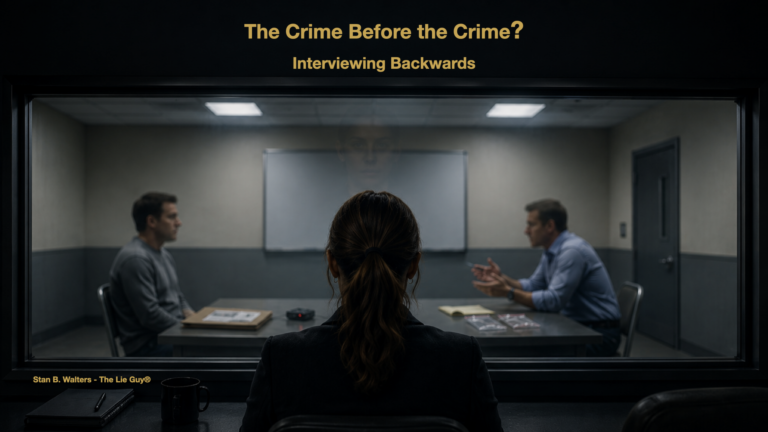
Subjects frequently expect investigators to begin with the offense and move forward chronologically. There is another approach. By working backward from the event and progressively exploring the decisions that preceded it, investigators can uncover inconsistencies, expose rehearsed accounts, and identify information that might otherwise remain hidden. Each answer leads naturally to another question about what happened before that point, gradually revealing the sequence of decisions that culminated in the criminal act. Rather than simply proving that a crime occurred, the investigator develops a reliable understanding of how the subject arrived at that moment. That deeper understanding often produces a stronger interview and a more defensible case.
The interview room is where investigators have the unique opportunity to uncover far more than the facts of the offense. Physical evidence tells us what happened. Effective interviewing explains how and why it happened. By looking beyond the event, examining the decisions that preceded it, and interviewing backward through the subject's narrative, investigators begin to uncover the crime before the crime. In many investigations, that is where the most compelling evidence is waiting to be discovered.
© Copyright by Stan B. Walters. All Rights Reserved.
Brief excerpts may be quoted with attribution and a link to the original article. Reproduction, redistribution, or use in training materials requires written permission.