Narrative or Accusatory?
Every investigative interview begins with a decision long before the first question is asked. Is the objective to obtain agreement…or to discover reliable information? That single choice influences the questions investigators ask, the information they collect, and ultimately the strength of the case they present.

The Crime Before the Crime?
Most investigators begin with the crime itself. But the strongest interviews often uncover something that happened long before the event—the decisions, planning, motivations, and circumstances that created the path to the offense. Discover how interviewing backward can reveal the crime before the crime.

Yackety Yak Will Cost You The Facts
Many investigators believe talking demonstrates control. In reality, excessive talking interrupts memory retrieval, suppresses the subject’s narrative, and reduces statement reliability. Learn why purposeful silence is one of the most powerful tools in investigative interviewing.
These articles introduce the Cognitive Reliability Framework™ and examine evidence-based methods for diagnosing interview dynamics, protecting statement integrity, and evaluating the reliability of information obtained during investigative interviews.
Select a title to explore how research in memory, cognition, communication, and decision-making can be applied to produce cleaner, more accurate, and more defensible statements.
These articles examine how interview structure, question design, strategic silence, and narrative development influence the quality and completeness of the information obtained.
Select a title to explore practical methods for helping subjects recall, organize, and communicate information without unnecessary interruption, suggestion, or contamination.
- “Beam Me Up, Scotty”: Where Did Your Interview Method Come From?
- The “Pause” — An Effective Interview Technique
- How to Avoid Interrogation Failure
- Over-Prepared Interviews: Interrogator Paralysis
- The Attention-Distracted Interviewer
- Yakety Yak Will Cost You the Facts
- What Makes an Interviewer Effective?
- The Angry Subject in the Interview Room: When Listening Stops Progress Fails
- The Angry Interviewer: When Being Right Goes Wrong
These articles examine why subjects choose to disclose, withhold, agree, or confess—and how perceived gain, risk, pressure, rapport, and persuasion influence those decisions.
Select a title to explore ethical influence strategies that encourage information without introducing coercion, contaminating the statement, or compromising its reliability.
These articles examine how memory can be disrupted, altered, or contaminated during an interview—and how suggestion, repetition, pressure, and investigator-supplied information can contribute to unreliable statements and false confessions.
Select a title to explore practices that protect independent recall, preserve statement integrity, and reduce the risk of creating information rather than recovering it.
- Insuring the Confession Against the Allegation of False Confession
- Acceptance Is Not Authorship
- Yakety Yak Will Cost You the Facts
- The “Pause” — An Effective Interview Technique
- How to Avoid Interrogation Failure
- False Confessions: Who’s Responsible?
- Understanding, Avoiding, and Reducing the Risk of False Confessions — Published book chapter in Principles of Kinesic Interview and Interrogation (CRC Press, 2002)
These articles examine how confirmation bias, preconceptions, stress reactions, and unsupported interpretations of body language can distort an investigator’s assessment of credibility.
Select a title to explore why behavior must be tested against facts and context—and how analytical diagnosis produces more reliable conclusions than intuition or presumed deception cues.
Articles
Judging the Credibility of Criminal-Suspect Statements: Does Mode of Presentation Matter?
Journal of Nonverbal Behavior, 30(4), 181–198 (2006) · Peer-reviewedBehavioral Cues to Deception vs. Topic-Incriminating Potential in Criminal Confessions
Law and Human Behavior, 29(6), 683–704 (2005) · Peer-reviewedDefensive Demeanor Profiles
American Journal of Dance Therapy, 22(2), 103–121 (2000) · Peer-reviewedMislabeling Common Stress as Deception: The Error of Biased Analysis
The Eye Movement Myth: When Bad Science Enters the Interview Room—and Eventually the Courtroom
A Cluster of Bad Cues Is Still Just Bad Cues: Rethinking Stress, Deception & Behavior Cues
The Risks of Echo Chamber Training: “Beam Us Up, Scotty”
Research Presentations
- “Verbal and Nonverbal Cues to False Testimony in Criminal Investigations” — Presented at the American Psychological Association Annual Convention, Washington, DC (2000) · Research presentation
These articles examine whether investigative interview methods can be explained, supported, and defended when subjected to legal, scientific, and professional scrutiny.
Select a title to explore method validation, statement reliability, false-confession risk, diagnostic reasoning, and the practices that determine whether an interview withstands evaluation in the courtroom.
Articles
- Why Isn’t Interview and Interrogation Training Audited Like Use-of-Force Training?
- Judging the Credibility of Criminal-Suspect Statements: Does Mode of Presentation Matter?
Journal of Nonverbal Behavior, 30(4), 181–198 (2006) · Peer-reviewed - Behavioral Cues to Deception vs. Topic-Incriminating Potential in Criminal Confessions
Law and Human Behavior, 29(6), 683–704 (2005) · Peer-reviewed - Daubert Standards for Interview & Interrogation Training
- Will Your Interview Training Survive a Daubert Challenge?
- Beam Me Up, Scotty”: Where Did Your Interview Method Come From?
- Insuring the Confession Against the Allegation of False Confession
- Acceptance Is Not Authorship
- Intuitive versus Analytical Diagnosis of Credibility
- How to Avoid Interrogation Failure
- Narrative or Accusatory?
- Will Your Interview Training Survive Courtroom Scrutiny?
- When Interview Methods Are Challenged, Reliability Has to Answer
- The Eye Movement Myth: When Bad Science Enters the Interview Room—and Eventually the Courtroom
The Interview Room is Stan B. Walters’ professional article series addressing investigative interviewing, interrogation, statement reliability, deception diagnostics, and evidence-based interview practices.
The articles below were originally published through The Interview Room and are preserved here for investigators, trainers, attorneys, and researchers. Select a title to read the archived article on The Lie Guy® Blog.
- Confession Motivators: Gain or Pain? January 2008
- Try a Little P.A.S. in Your Interview April 2003
- The Truth About Body Language and Deception August 2005
- The Narrative-Based Interview – Filtering Technique September 2007
- The Pre-Conception: An Interrogation Assassin October 2006
- Insuring the Confession Against the Allegation of False Confession November 2002
Explore Stan B. Walters’ published research, professional articles, conference contributions, books, and scholarly records across these research platforms.
Continue exploring these subjects through selected video collections covering interviewing, interrogation, investigative decision-making, and practical application.
Inside the Interview Room – YouTube Playlist 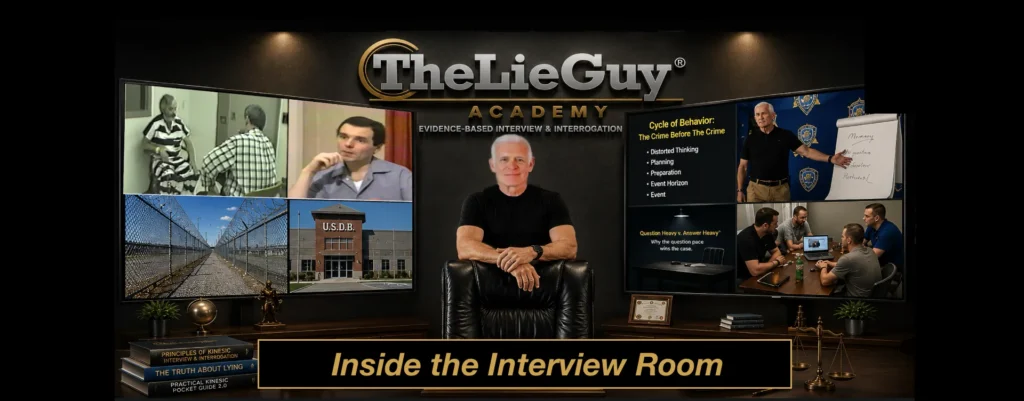
101 Tips for Interviewing and Interrogation YouTube Playlist